

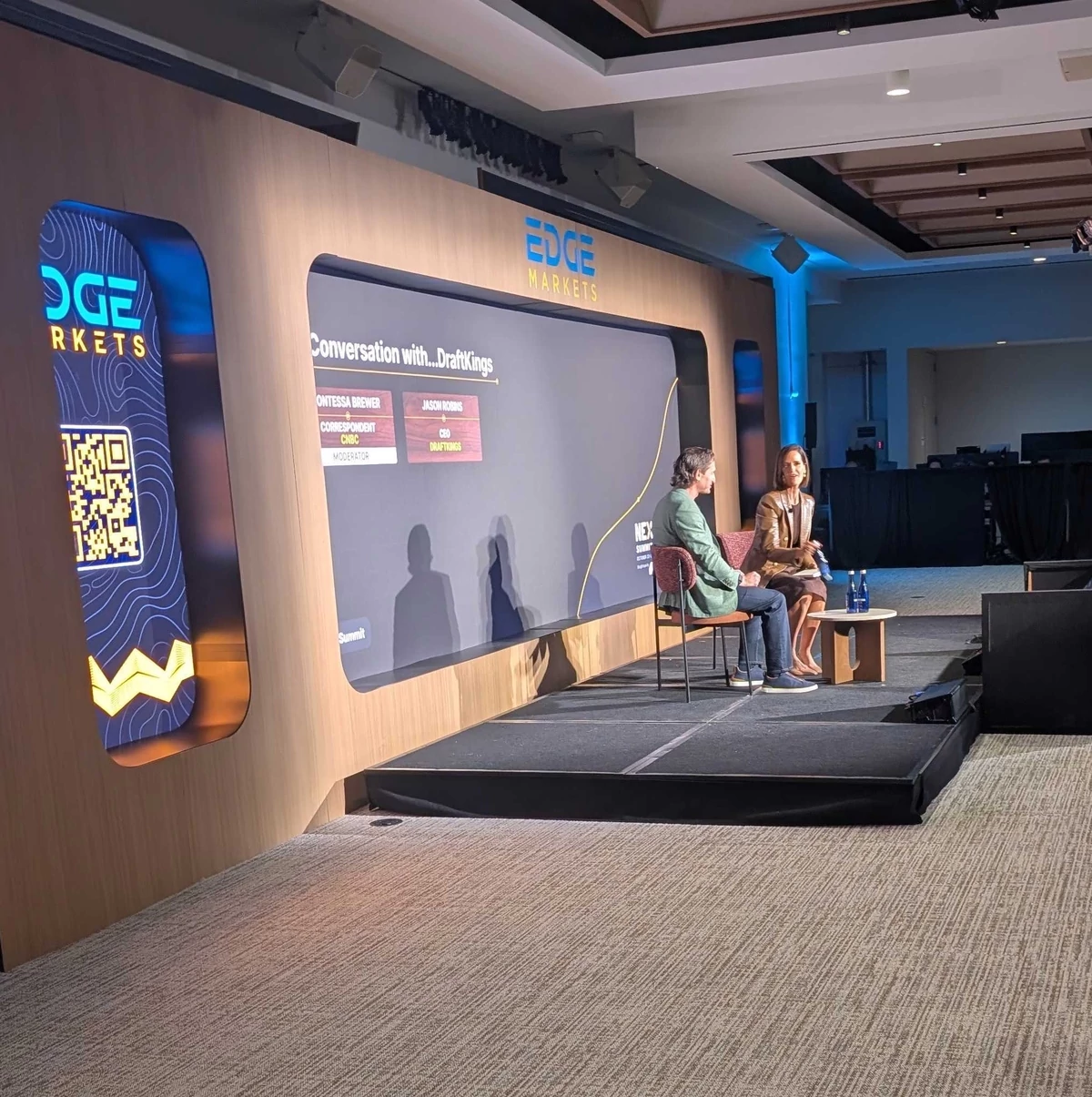
Trade Handle is covering NEXTPredict NYC live from New York City on October 22, where DraftKings co-founder and CEO Jason Robins joined CNBC correspondent Contessa Brewer for a conversation about the company's growing prediction markets business.
During the afternoon session, In Conversation with... DraftKings, Robins discussed how quickly DraftKings has gained ground, the company's approach to regulation, and why non-sports markets have become a bigger opportunity than he originally expected.
He also addressed concerns about artificial intelligence, responsible trading, and whether prediction markets could eventually threaten DraftKings' existing business.
DraftKings Claims a Top-Three Position
Robins opened with a bold assessment of DraftKings' early progress in prediction markets, claiming the company has already become one of the industry's three largest platforms. "Remember, we only launched DraftKings Predictions a few months ago, and we're already clear number three," Robins said.
He emphasized that growth has come despite DraftKings operating its sports prediction markets in fewer states than some competitors. Robins credited the company's existing technology and years of experience building consumer products for helping it move quickly. "We know what works. We know what customers want," he said.
Non-Sports Markets Have Surprised Robins
One of the more revealing moments came when Brewer asked whether DraftKings would still pursue prediction markets if traditional sportsbooks became available nationwide. Robins said he would, particularly because of opportunities outside sports. "I think so. Especially in non-sports, there's still a ton of content there," he explained.
He highlighted elections and financial markets, admitting the latter had performed better than he expected. "We've actually been pleasantly surprised at the growth there," Robins said. "I got to admit I did not expect that." Robins acknowledged that he had previously underestimated the opportunity. As customer interest grew, DraftKings began investing more resources to expand those offerings.
DraftKings Believes It Can Win Either Way
With legal challenges surrounding sports prediction markets potentially reaching the Supreme Court, Brewer asked how DraftKings was preparing for an uncertain regulatory future. Robins explained that the company deliberately avoided offering sports prediction contracts in states where it already holds sportsbook licenses.
That decision, he said, protects its established business while allowing DraftKings to compete in the growing prediction markets industry. "We actually feel like we put ourselves in this win-win spot where no matter what the outcome of that whole process is, we are well positioned going forward," Robins said. He also emphasized the importance of maintaining positive relationships with state regulators rather than risking existing licenses.
Robins Pushes Back on AI Criticism
Brewer challenged Robins about reporting concerning DraftKings' use of artificial intelligence and whether technology could be used to target vulnerable customers. Robins rejected that characterization, arguing that the company primarily uses AI and machine learning to improve its technology and personalize content. "I think the degree to which AI is used is a bit overblown," he said.
He explained that recommending relevant content based on customer preferences is different from encouraging harmful behavior. "We are certainly not trying to proactively target those people," Robins said, referring to customers who may be experiencing problems with their activity. He added that DraftKings has a specialized team that reviews accounts raising responsible engagement concerns.
Responsible Trading Tools Carry Over to Predictions
Brewer also asked whether prediction markets should have the same consumer protection measures used in DraftKings' existing products. Robins said the company has already taken that approach, applying its established responsible engagement practices to prediction markets. "We apply the same responsible trading tools," Robins said.
He argued that the industry doesn't necessarily need to create an entirely new system when it can adapt and improve established safeguards. Robins also acknowledged that identifying customers who may need assistance isn't always straightforward, making monitoring and intervention important parts of the process.
Institutional Traders aren't DraftKings' Priority
Another interesting moment came when Brewer asked whether DraftKings planned to build products specifically for institutional traders. Robins said increased institutional participation could make prediction markets less attractive to everyday customers. "The more of that you introduce into a peer-to-peer ecosystem, the faster that the retail customers will have to spend money to keep up," he said.
Although DraftKings cannot necessarily prevent institutional traders from participating, Robins said the company has chosen not to prioritize features designed specifically for algorithmic trading firms and institutional investors. His comments highlighted DraftKings' focus on building a prediction markets business around retail customers rather than professional trading activity.
The Trade Handle Prediction Markets Take
Robins' appearance at NEXTPredict NYC showed how seriously DraftKings is taking its expansion into prediction markets, even while protecting its existing sportsbook business. His admission that financial markets have exceeded expectations was particularly interesting, especially considering how heavily the industry's early growth has centered on sports.
DraftKings is approaching prediction markets with an established customer base, existing technology, and experience navigating regulation. Whether that strategy eventually puts the company alongside the industry's biggest exchanges remains to be seen, but Robins clearly believes DraftKings has positioned itself to succeed regardless of how the regulatory landscape develops.