

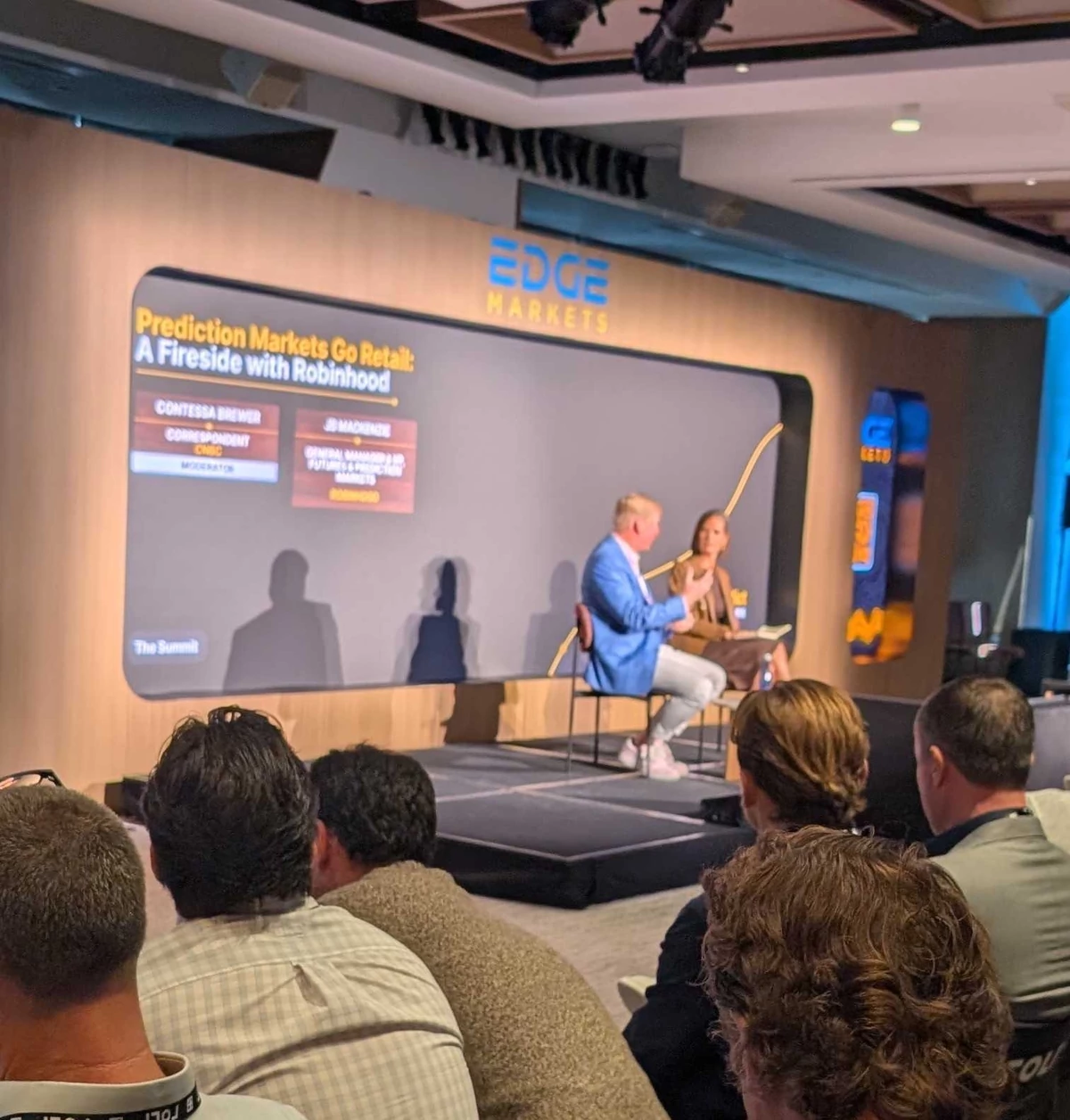
Trade Handle is on site at the 2026 NEXTPredict NYC, where Robinhood General Manager and VP of Futures & Prediction Markets JB Mackenzie sat down with Contessa Brewer to discuss the evolution of the industry and Robinhood’s place in a constantly evolving environment.
During the sit-down of Prediction Markets Go Retail: A Fireside with Robinhood, Mackenzie touched on numerous topics. Those included the company’s next big growth opportunity, a shift in how customers use prediction markets, and how prediction markets enable mainstream investing.
Mackenzie also dove into retail participation, Robinhood’s non-sports offerings, and regulatory concerns. He also touched on how Robinhood is positioned for long-term success despite ongoing legal battles for prediction markets.
Political Markets Offer More Clarity Than Polls
The interview opened with Contessa Brewer asking Mackenzie about the impact of election betting, using the 2026 Midterms as a launchpad. Brewer suggested prediction markets could be used to gauge voter sentiment. She then asked Mackenzie what Robinhood event contract data tells traders and industry participants about political races.
Mackenzie mentioned how Robinhood “just launched” an updated Midterm election hub. He stated that it not only displays the races mapped out, but also gives users granular data down to each district. This allows traders to “click into” each district to assess real time probability of each race.
On top of this hub, Mackenzie noted how prediction markets and traditional polls are not aligning. Mackenzie stated polls may often suggest a race is a “toss up”, whereas Robinhood polls may show a 70% to 30% lean.
Surface Level Data Isn’t Swaying Traders
Brewer asked what is causing this discrepancy, but took it one step further to ask what creates big waves of change in regards to trade volume on political markets.
The question was steered toward the impact of surface level information like political debates. Mackenzie offered that debates didn’t shake up the trading nearly as much as economy reading, with things like PPI, CPI, and federal rates being raised all seeming to influence movement.
Not Just About Sports
Sports event contracts have been a huge player for prediction markets, but Brewer next noted that Robinhood’s biggest event contract in September had nothing to do with sports.
Mackenzie agreed, revealing that it was the Fed decision. He added that traders and general people have a genuine interest in the outcome and overall impact, saying, “People are genuinely interested in knowing what is going to be the impact of the Fed."
Mackenzie then touched on how prediction markets boil down to probability, which prompted Brewer to ask if a clearer understanding makes prediction markets more appealing to younger traders who may not fully understand futures, options, and more complicated financial derivatives.
Mackenzie agreed, saying the simplicity of only two choices for each market, regardless of how intense the material might be, gives the trader “a feeling of confidence" to make a well-informed trade.
Moreover, Mackenzie views the structure of prediction markets as a new opportunity to educate younger investors, while the ease of use should allow the industry to expand.
Pulling Out the Rug
Continuing on the impact of sports contracts on Robinhood, Brewer questioned where the company is positioned if sports markets or other event contracts are wiped out by lawmakers.
Mackenzie highlighted that “an evolution” is already starting to occur. He admitted that sports contracts are admittedly a big part of the appeal of prediction markets, but he singled out price volatility contracts (Bitcoin, crude oil, gold, etc) and noted they are some of the fastest growing markets available.
Per Mackenzie, these untapped markets could grow even more, and they may very well be the part of the next wave of evolution within the industry.
Appealing to Retail Investors
Brewer asked if these would-be fringe contract markets could be made appealing to retail investors, to which Mackenzie replied, “absolutely”. He answered this understandable concern by suggesting retail investors would be wielding far more control and direct influence in prediction markets than most people realize.
Mackenzie also downplayed the risk to retail investors, suggesting a multi-layered approach due to information availability should mitigate time constraints, as well as base market probability.
Mackenzie also feels that the interest of retail investors can transition regular users into other offerings on Robinhood. He noted that prediction markets may be an intriguing add-on for users, but that anyone coming to Robinhood will almost immediately begin building out “into equities, crypto, futures, options”, while they also quickly realize other capabilities of the platform, including IRA accounts.
Responding to Age Restrictions
Brewer mentioned how Novig has taken a strict stance on age restrictions, setting a 21+ age limit for their prediction markets platform. Mackenzie disagreed with the harsh stance, suggesting that if you’re old enough to open an equity account, trade options, or trade futures, all at just 18.
Robinhood’s official stance as far as age restriction is 18+, and Mackenzie echoes that with understandable logic. He also took it a step further and put the onus on education prior to the age of 18 so young users know how to utilize these types of financial products, as well as to know how to not misuse them.
Mackenzie on International Growth
Robinhood recently got their DFSA approval in the UAE, giving Robinhood a clear path to “open up soon” in Dubai. Mackenzie noted the company intends to “build out our footprint”, with company CEO Vlad Tenev being outspoken about the company’s plight to expand globally.
Brewer asked how Robinhood intends to facilitate their strategy, and Mackenzie noted the company already has access to the United Kingdom and Singapore. In addition to their growing worldwide access, Robinhood has a company-wide belief that the same financial interests in the U.S. are shared globally.
Mackenzie noted that the cost to trade can vary depending on location, and the site’s motto “democracize finance for all” pushes them toward expansion.
Prediction Markets’ Most Pressing Challenge
Asked about the industry’s most pressing challenges moving forward, Mackenzie started by agreeing clarity from a regulatory perspective will be important. The bigger issue in his opinion, however, is the perception of prediction markets.
Per Mackenzie, “There’s a perception that prediction markets are dangerous.” With both sides attacking each other over integrity, there is a perception created that Robinhood and other prediction market platforms either aren’t regulated, or that they are doing something wrong.
Mackenzie suggested perception is more important than legal or regulatory issues. Negative perception can keep Robinhood and other prediction markets from growing, making it a point of emphasis for the company.
The Trade Handle Prediction Markets Take
Robinhood's message via Mackenzie: the site is about growing financial wealth and there are different ways to do it. Prediction markets are just one of them.
Mackenzie stated the focus for new users should be developing a financial portfolio. Robinhood gets users started with an easy-to-understand product like prediction markets. From there, they can develop their financial strategy.
Overall, it appears Robinhood is in position either to thrive with a growing prediction market industry, or survive without it. Mackenzie answered pressing questions perfectly, setting up Robinhood as an all-in-one spot for new and informed financial traders.