

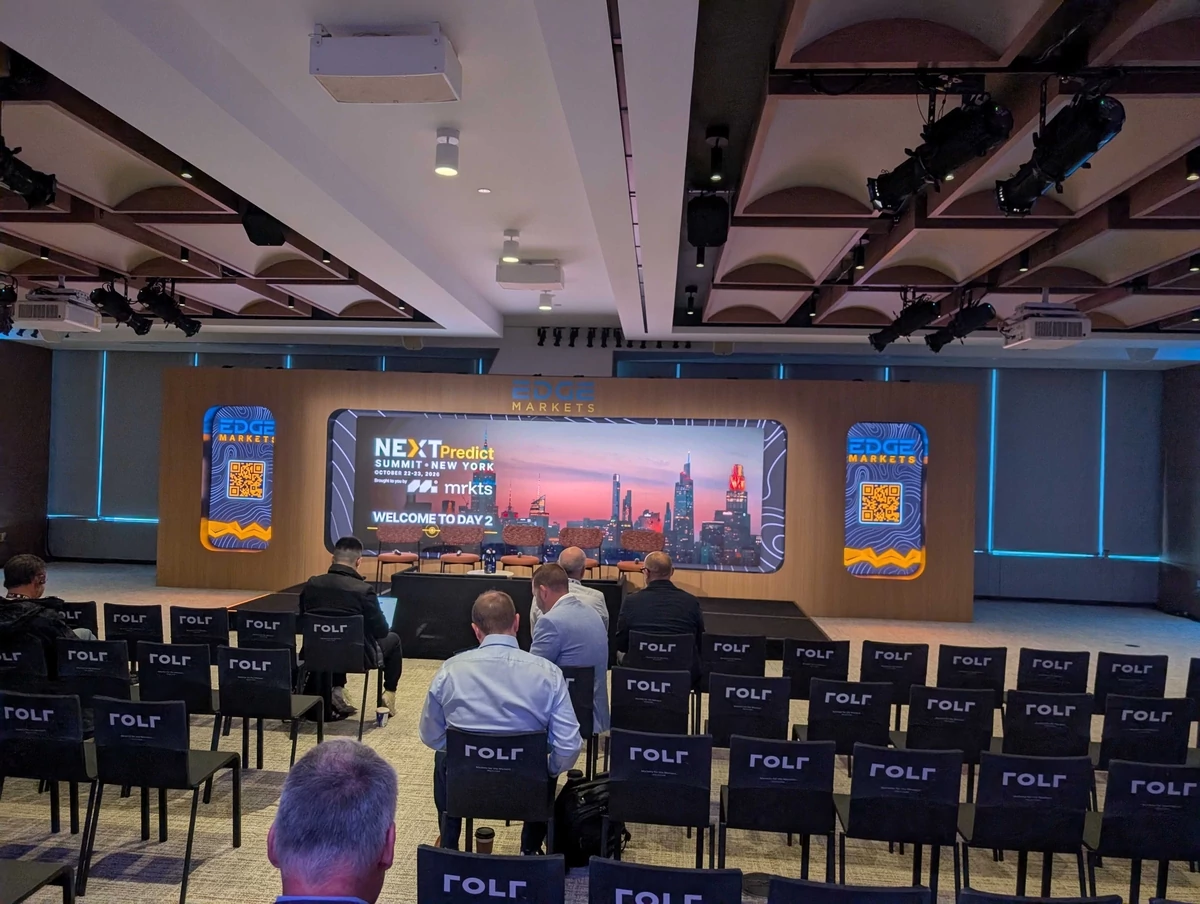
Trade Handle was live at NEXTPredict 2026 in NYC, where Reuters Financial Regulation Correspondent Douglas Gillison led a conversation on prediction market insider trading.
Gillison moderated a sit-down with Polymarket Deputy Chief Legal Officer Olivia Chalos and Wilmerhale’s Futures & Derivatives Practice’s Matthew Kulkin. The three discussed how prediction markets can stay clean, detect and fight insider trading, and improve trust.
Insider Trading Isn’t New
Douglas Gillison opened the panel discussion by noting that prediction markets are experiencing a surge of growth and overall interest. He cited numerous high-level prediction market insider trading scandals before asking Kulkin and Chalos what their main concern was regarding corruption on their platforms.
Kulkin admitted it was a fair question, but also noted that insider trading is “not new”. He suggested it’s always been policed and prosecuted, and the situation isn’t different when it comes to prediction markets.
Kulkin said, “It’s important to remember that futures markets are different from securities markets.” He used a farmer hedging risk against his crops as an analogy for futures markets, and pointed out it can be similar for companies. The key difference as it relates to insider trading is when someone can exploit privileged information for their own gain.
The onus should be put on the companies or entities who possess privileged information, per Kulkin. He also suggested prediction market regulators should work to further establish boundaries and guidelines to limit infractions.
When It’s Not Insider Trading
Gillison extended the same question to Polymarket’s Olivia Chalos. She answered, saying, “I think there are two key points that you raise.” She went on to agree on standard insider trading, but also pointed out politicians trading on event contracts dealing with their own election.
The second part, per Chalos, isn’t classified as insider trading. Regular insider trading deals with individuals or entities who can benefit from having information the public doesn’t. However, in other cases, an individual may have complete control of the outcome, or may at least greatly influence it.
Chalos declared Polymarket sets the guidelines for this type of infraction, saying, “It’s a rulebook violation, but the other piece is they could potentially be manipulating the market.”
Elections Are Their Own Unique Problem
Chalos suggested election contracts are “particularly interesting” as they look at how to monitor trades. Polymarket has to consider not just who may have inside information for an event contract, but also if there is an interest in simply altering the market’s outcome aesthetically.
A hypothetical was broached by Chalos, who suggested a foreign country could possibly make trades to display results that don’t accurately reflect how a race or market is unfolding in real time.
While that particular dilemma has yet to happen on Polymarket, this unique market type creates a variety of different market manipulation concerns.
What Keeps You Up at Night?
Gillison tried to dig deeper, asking the panel what worries them most in regards to potential insider trading concerns.
“All of it”, Chalos replied, partially in jest, but calibrated to state that overall market integrity is “really important”. She also admitted that different types of markets provide their own unique challenges, while admitting Polymarket needs to work to be one step ahead of bad actors.
Another challenge for Polymarket and most other prediction markets is a giant retail base. There is inherent risk in having a large number of traders entering almost endless markets. Due to that, Chalos doubled down on Polymarket’s plight to protect consumers, and also to educate them of the risk involved.
Mapping Out a Detection Puzzle
Gillison asked Chalos specifically what goes into Polymarket’s detection policy. Chalos responded by stating the company will acquire a growing list of election candidates to keep tabs on, but circumvention detection is also in play.
The bigger priority, though, is behavioral markers. Chalos declares them to be “the best signal”, which can be followed up by a full investigation. On top of this process, Polymarket is constantly collecting data that is relevant to their open event contracts.
Chalos also noted that it is much easier to detect bad actors “on chain”, which allows for an “enormous amount of information”, as well as reveals digital foot prints. The ability to source traces of funds and secure other information can facilitate speedy detection.
Obligation of the CFTC
Kulkin chimed in on the conversation, stating that the CFTC has a clear “obligation” in their role, and that is to surveil the market, as well as potential bad actors.
The CFTC is also tracking results of these markets, with a particular interest in unusual patterns or behavior. When this happens, accounts get flagged and investigated.
The Trade Handle Prediction Markets Take
The prediction market industry is growing rapidly. With that growth, more and more insider trading situations are bound to pop up. The number we’ve seen documented already suggests as much, but the good news is Polymarket, Kalshi, and other sites all have processes in place to protect users and markets.
The important takeaway here isn’t data collection, insider trading definition, or even infraction detection. It’s that insider trading isn’t new, and it’s just the unfortunate cost of doing business in an industry dealing with individual and corporation profit on the line.
Polymarket’s transparency with their process and the eagerness to improve is also a positive. These companies don’t want to be dinged for a negative occurrence that existed long before they did, but they’re still willing to be part of the solution.