

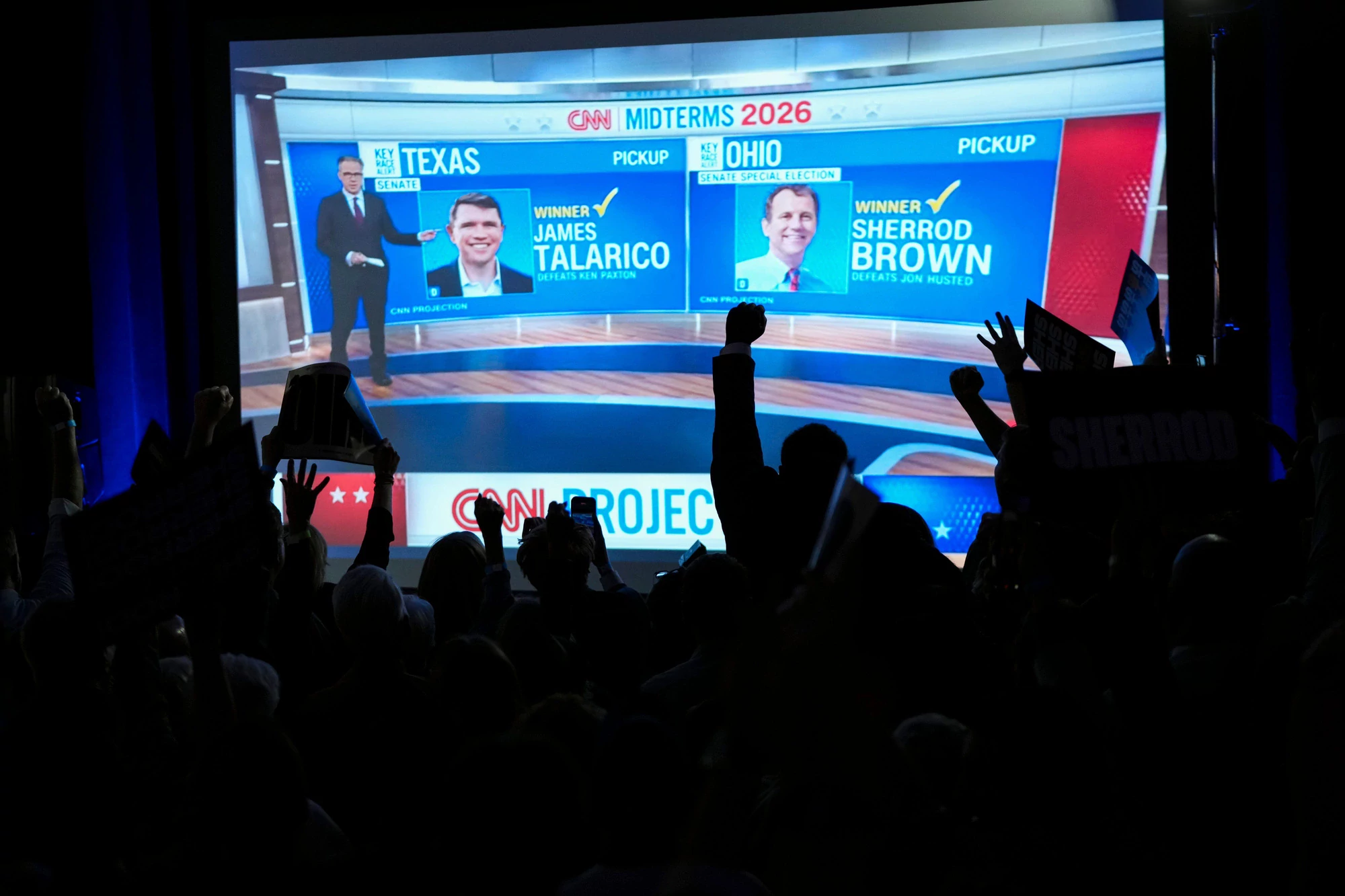
As more results are released across the country, prediction markets continue to prove they largely called the midterm elections to a T.
Operators such as Kalshi and Polymarket expected a “Blue Wave,” which came in full force on election night. Democrats achieved majorities in the U.S. House of Representatives and the U.S. Senate, and voters chose more Democratic than Republican governors.
Prediction markets in form during midterm elections
Prediction markets are a direct reflection of user sentiment. That extends beyond simple thoughts and opinions since every contract purchase is tied to a financial commitment, implying a level of seriousness in every trade.
Before the first polls closed at 6:00 p.m. ET on the night of the midterm elections, prediction markets clearly expected Democratic majorities in both congressional chambers. They also believed that Democrats would win at least 53 seats in the Senate, with the 54th being a toss-up. With two races in Mississippi and Alaska still being decided, Democrats have already won 54 seats.
The “toss-up” was a race between Josh Turek (D) and Ashley Hinson (R) in Iowa. Prediction leader Kalshi flipped its favorite twice in the 48 hours leading up to polls closing and didn’t have either candidate as greater than a 53% favorite until Turek pulled away when votes were counted.
Prediction companies were also calling races on their social media pages on Tuesday night, similar to how news stations call races once a certain number of votes are counted. Kalshi spokesperson Jack Such said that Kalshi called races if a candidate’s likelihood exceeded 99% and trading activity for their opponent “dried out.”
Polymarket claimed to have called 10 key races ahead of leading election news sources, including the Associated Press, CNN, and Fox News.
“It’s now routinely hours between when prediction markets call it versus the TV networks,” said Polymarket CEO Shayne Coplan in an X post. “No knock to them, but now there’s Polymarket, and many people are realizing they want to know what’s happening in real time.”
Highs and few lows
Prediction markets were among the first entities to suggest that President Donald Trump would win his re-election bid in 2024, while many polls still showed a toss-up between him and Democrat Kamala Harris.
The midterm elections offered prediction markets the chance to further legitimize themselves if they could deliver accurate and timely insights.
Just like the last presidential election, prediction markets had resounding success during the midterm elections. Nearly $200 million was traded in Kalshi’s Texas Senate market, in which traders never had James Talarico (D) as less than a 66% favorite in the week build-up to election day. Most polls showed Ken Paxton (R) was still very much alive to win the seat in the Senate, but traders never gave him a significant chance.
Still, the platforms weren’t perfect. They favored the wrong candidates in several races, including the Texas Governor race that generated $108 million in notional trading volume. Kalshi had incumbent Greg Abbott (R) as a 61% favorite until one minute after the polls first closed, at which time Gina Hinojosa (D) took over as a 54% favorite.
But despite those oversights, prediction markets proved they could hang with polls and institutionalized news sources.
“Last time around [in 2024], prediction markets were in the discussion, but they were in the discussion in a way that was a little bit unsure,” said Harry Crane, a statistics professor at Rutgers University. “This [was] the first true prediction markets election.”
The Trade Handle Prediction Markets Take
The speed and accuracy of prediction markets were on full display during the midterm elections. Polymarket’s Coplan’s claims that markets called races faster than traditional mainstream news sources further suggest that prediction market data is now the most accurate representation of the population’s feelings and opinions, as polls introduce bias and are not always representative.