

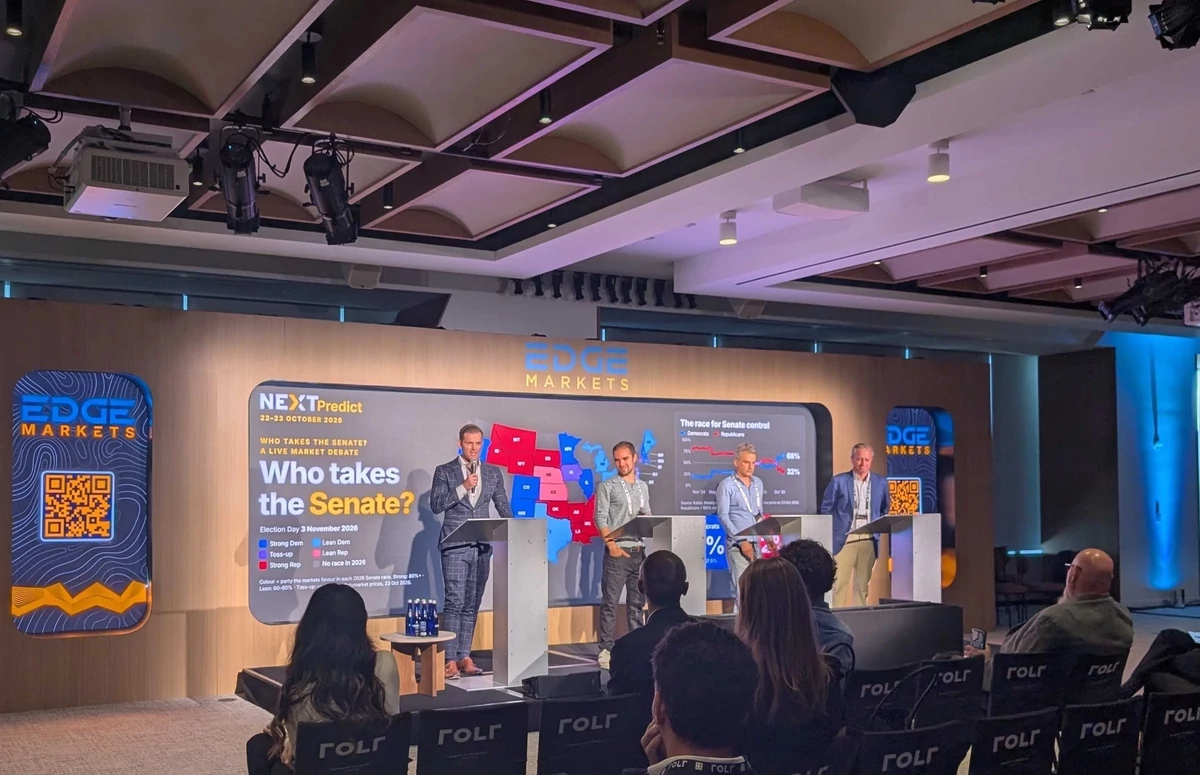
Trade Handle was on the ground covering NEXTPredict NYC on October 23, where one of the conference's most entertaining sessions brought three experienced prediction market traders together to debate control of the U.S. Senate. With the November 3 midterm elections approaching, the panel put real trading positions, market prices, and competing political theories under the spotlight.
The session, "Who Takes the Senate? A Live Market Debate," was hosted by Dalton Skach of the Betting the Future podcast. Joining him were professional trader David Bensoussan (known as Scottilicious), Circuit co-founder Matt Weiss, and High Roller Chief Business Officer Flip Pidot. Their discussion quickly turned into a debate over whether traders were pricing in the possibility of a closely divided Senate correctly.
A $220,000 Position Behind a Republican Senate
Matt Weiss came into the discussion with significant money exposed to the election's outcome. He disclosed that he stood to lose approximately $220,000 depending on the result and said he did not intend to close his position before election night. Weiss argued that Republicans had a stronger path to retaining Senate control than market prices suggested, particularly if the chamber finished with a 50-50 split.
"I strongly believe that we will have a 50-50 election," Weiss said. His argument centered on individual candidates and the differences between smaller and larger states. He pointed to Republican strength in Maine and Alaska while expressing skepticism that Democrats could win Texas. Weiss also believed the market was underestimating how competitive the final result could become. He expected trading prices to tighten as election day approached.
Scottilicious Sees Opportunities in Texas and Alaska
David Bensoussan took a different approach, focusing less on the overall Senate contract and more on individual state markets. He favored a Democratic path to control, with Texas and Alaska among the races attracting his attention. Bensoussan challenged the idea that polling alone could explain the election. He argued that political dissatisfaction, voter enthusiasm, and cultural influences could affect turnout in ways traditional surveys might miss.
"I look at cultural variables. I look at historical analyses. I, you know, go on the ground," Bensoussan explained. Texas became one of the liveliest points of disagreement. Bensoussan argued that Democratic candidate James Talarico could benefit from crossover support and dissatisfaction among some Republican voters, while Weiss remained unconvinced that Texas would change hands. Alaska was another major point of disagreement. Bensoussan highlighted the state's independent voters, its ranked-choice voting system, and candidate-specific factors as reasons he believed the race deserved closer attention.
Flip Pidot Questions His Own Trading Instincts
Flip Pidot offered perhaps the most interesting perspective of the session because he openly admitted his personal analysis conflicted with what other experienced traders told him. Pidot said Republican prices appeared attractive based on his interpretation of the electoral landscape. However, conversations with traders whose judgment he respected persuaded him to favor Democrats instead.
"I've learned to defer to smarter traders," Pidot said. That tension captured an important part of prediction market trading. A trader can believe a contract is mispriced while recognizing that other market participants may have information or analysis worth considering.
Pidot also discussed the difficulty of interpreting polling errors and national political trends. His comments reinforced how uncertain individual Senate races could remain, even when traders were confident about the broader political environment.
Maine, Michigan, and the States That Could Decide Everything
Although Texas received plenty of attention, the panel spent considerable time discussing Maine and Michigan. Weiss and Pidot expressed confidence in Republican Senator Susan Collins' ability to remain competitive in Maine despite the state's Democratic voting history in presidential elections. Bensoussan was more cautious, describing the race as difficult to judge.
Michigan produced a somewhat different discussion. Panelists generally viewed the Democratic candidate as having an advantage, although they acknowledged that national political shifts could change the picture. The debate repeatedly returned to one central question: whether individual candidates could outperform their party's broader political standing.
Three Traders, Two Different Outcomes
By the end of the session, the panelists had not reached a consensus. Weiss maintained his expectation of a 50-50 Senate, while Bensoussan and Pidot finished predicting a 51-49 Democratic majority.
The discussion was particularly interesting because the participants reached their conclusions in very different ways. Weiss emphasized electoral structure and candidate strength, Bensoussan focused on state-level opportunities and voter behavior, and Pidot weighed his own analysis against other professional traders' judgment.
For Trade Handle, covering the debate live at NEXTPredict NYC offered a firsthand look at how experienced market participants approach one of the year's biggest political contracts. Their predictions are now on the record, and November 3 will provide the results against which those calls can be evaluated.
The Trade Handle Prediction Markets Take
The biggest takeaway from this session wasn't which party the panelists favored. It was how openly they challenged one another's assumptions while backing their views with actual trading positions.
Prediction markets get more interesting when traders explain why they disagree, especially when meaningful capital is on the line. This panel showed how much debate can exist behind a single market price, even among people who spend their careers studying these contracts.