


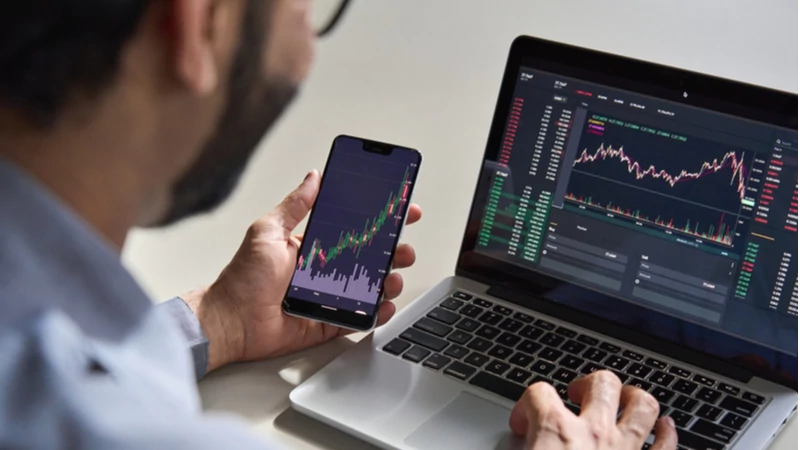
Why everyone’s talking about prediction markets
Unless you’ve been living under a rock, you will already be more than familiar with the prediction markets phenomenon. It’s something that’s caught on like wildfire across the US over the past few years, but not everyone knows what it is just yet.
We’ve created this handy guide that asks, ‘What are prediction markets?’, but we’ll try and give you the basics right here. Prediction markets are basically where you can buy and sell contacts on real-world events. This could be something like who will win the next US election, which team will win the NBA Finals, or even if aliens will invade planet Earth.
The key thing to note is that the price of the event contracts you buy is entirely based on public opinion. So if you saw a contract with a price of $0.88 that there will be a global recession this year, it would have a stronger chance of happening compared to a contract for $0.12 of there not being a global recession.
The whole concept behind this is that you are effectively ‘putting your money where your mouth is’. So as well as being able to make some returns by winning your prediction, such prediction markets are also pretty useful tools of public opinion.
A quick prediction markets timeline
The basic concept of prediction markets has been around for longer than you might have thought. Check out this timeline to see how it has evolved through the ages:
| Year | What happened |
| 1st century BC | Roman citizens used to make predictions about who would win chariot races and back these predictions up with their money. |
| 1503 | First recorded example of people making money predictions about who would be the next Pope. |
| 17th century | The Tontine is introduced in Italy as a form of investment plan where investors received greater returns as other participants died. |
| 1884 | First example of US election cash predictions being made on Wall Street. |
| 1945 | Friedrich Hayek publishes his influential article ‘The Use of Knowledge in Society’ demonstrating the potential power of prediction markets. |
| 1988 | The Iowa Electronic Markets is introduced as the first modern electronic prediction markets for predicting the 1988 US presidential election. |
| 2004 | HedgeStreet became the first prediction market to be granted approval by the Commodity Futures Trading Commission. Other brands like Intrade followed but such activity was shut down due to legal uncertainties. |
| 2005 | Google reveals that it had been using prediction markets for forecasting everything from new product launch dates to office openings. |
| 2014 | Decentralized prediction markets brands like Augur emerge to utilize blockchain technology in their trading sites, eventually paving the way for the likes of Polymarket. |
| 2024 | Kalshi wins a pivotal lawsuit against the CFTC which eventually allows it to host prediction markets for the US election. This opens the floodgates to the current wave of prediction markets sites. |
What early prediction markets were there?
Making predictions is a fairly basic human instinct, and it’s little wonder that people have been backing up their predictions with money all the way back to the Roman era and probably before. As far back as the first century BC, there is evidence of citizens making predictions on everything from chariot races to gladiatorial contests. Such predictions were typically made on a peer-to-peer basis as is seen on prediction markets sites today.
From here, such activity has been witnessed in many sectors, most notably around papal elections. The peak of this occurred in the 16th century when it was very common for people to make predictions on who the next Pope would be, and a ban was issued to stop this lasting all the way to 1918.
From here, there have been countless records of people making predictions on everything from other people passing through the Tontine investment schemes in Italy, to traders on Wall Street predicting the winner of the next US election in the late 19th century.
Prediction markets enters the modern era
The 20th century saw several key thinkers proposing that such public predictions could be used as a way of planning various civil matters more effectively. In particular, Friedrich Hayek's article 'The Use of Knowledge in Society' noted how market economies could be powerful tools for planning as they tie together dispersed knowledge from a variety of sources in a trustworthy way.
However, prediction markets got its biggest breakthrough when the University of Iowa created Iowa Electronic Markets. This was the first time that traders were able to buy and sell contracts on things like election results and economics. What's remarkable is that this proved to be more accurate than traditional polls as was seen when it got within half a percentage point of predicting the outcome of the 2008 US election.
Legal challenges and mainstream breakthrough
From here, there has been a battle for prediction markets brands to receive legal recognition. In particular, the Commodity Futures Trading Commission has repeatedly had to step in to shut down various prediction markets contracts as they were felt to be contrary to the public interest. This was especially the case in regards to topics such as political elections and terrorism.
Things came to a head in 2023 when the CFTC demanded that Kalshi cancel its event contracts for which party would control Congress. However, a year later Kalshi managed to overturn this decision and this has led the way for the massive range of predictions markets brands that we see today.
Similarly, Polymarket found itself barred from the US from 2022 to 2025 as it was found to be running an unregistered derivatives-trading site. Once again, this decision was overturned, this time thanks to the Trump administration's more lenient approach to financial regulation, and interestingly, Donald Trump Jr was added as an advisor to the prediction markets brand.
What can we expect from the evolution of prediction markets
One thing is for sure and this is that prediction markets are big news right now, and it's only getting more popular. There were an estimated 1.7 million monthly users of prediction markets in the US in January 2025, and this number had jumped to 8.58 million just a year later.
Much of this 400% increase is down to the sheer convenience of accessing these prediction markets sites and apps, as well as the fact that they are generally available in all 50 states.
With over $3 billion being traded every week, it's debatable as to whether this is a trend that's going to expand even further. Much of this will depend on how the regulatory powers aim to control the prediction markets phenomenon.
Multiple states such as New Jersey and Washington have filed lawsuits against prediction markets brands as they view them to violate their consumer protection laws. Plus Arizona recently filed the first criminal case against a prediction markets brand in its battle with Kalshi.
Such legal battles have brought in the federal government who have gone as far as suing states such as Connecticut, Arizona and Illinois for attempting to regulate prediction market brands. Ultimately the fate of prediction markets is likely to rest on who is sitting in the White House, and with the current President being seen as in favor of this phenomenon, it seems that prediction markets are just getting started.
Three brands who have made prediction markets history
It’s fair to say that the prediction markets phenomenon only really got going in the past decade. Much of this is down to the efforts of some key brands who have spearheaded the whole movement. So let’s have a quick look at how Kalshi, Crypto.com and Polymarket have brought prediction markets to the masses:
Kalshi - Bringing prediction markets to the mainstream

Kalshi: Pros and Cons
Pros
- CFTC-regulated prediction market
- US-based
- User-friendly interface
- Sport, politics, and more predictions
Cons
- High risk involved
You only have to read our Kalshi review to see exactly why this brand is the largest prediction markets site in the US. After all, everything about Kalshi is user-friendly from the well-designed site and apps to its charts that help you guide your next trades.
Kalshi was founded in 2019 but it didn't actually go live until 2022. Since then it has grown to command a reported 89% of the prediction markets market in the US and has even expanded into other countries such as Brazil.
Much of the appeal of Kalshi is based on its vast range of prediction markets where you can trade on anything from when the next lunar mission will be, to whether the US will invade Greenland. So while this brand may have been the first regulated designated contract market brand in the US, it is showing no sign of resting on its laurels.
Crypto.com - Cryptocurrency heavyweight moves onto prediction markets world

Crypto.com: Pros and Cons
Pros
- Focus on crypto and sports markets
- iOS and Android apps
- No-fee payments
- Top-tier account security
Cons
- No sign up bonus
This brand was actually launched back in 2016 with its main focus being on producing cryptocurrency debit cards. Since then Crypto.com has picked up over 150 customers worldwide, largely as a result of its crypto exchange.
However, Crypto.com has been quick to change with the times and recently moved into the world of prediction markets. This started off by allowing customers to trade on future events happening in the realms of politics, economics and sports. However, Crypto.com has recently added in new categories such as financials and culture.
Although the brand has faced cease-and-desist orders from certain states such as Nevada, it has been backed by the CFTC to continue operating in the US. Plus with a cash bonus for the first 10,000 participants to join its sports predictions product, it's going to be interesting to see where Crypto.com goes from here.
Polymarket - A game-changer in the prediction markets realm

Polymarket: Pros and Cons
Pros
- Safe and regulated by the CFTC
- Extensive range of Polymarket prediction markets
- No fees on deposits and withdrawals
- Sign up bonus and other rewards for active traders
Cons
- Requires crypto (USDC) to trade
Launched in 2020, this crypto-powered prediction markets brand has been ruffling more than a few feathers in its brief history. The site is built on Ethereum crypto technology and quickly gained notoriety for how it allowed customers to trade on the 2020 US election.
This caused the brand to come into conflict with the CFTC and the end result was that Polymarket had to close its doors to US customers in January 2022.
Thankfully that was only a temporary measure and Polymarkets grew significantly as a result of its coverage of everything from the fate of the Titan submersible to the 2024 Presidential election. Since returning to the US, our Polymarket review has found it to be nothing but a hugely enjoyable, and more importantly, legit prediction markets site.
Pros and cons of trading on prediction markets
So what is it about prediction markets that is so enduringly popular? While it’s a concept that has changed over the ages, the following pros and cons have remained roughly the same:
Pros and Cons
Pros
- Aggregate public trading into firm predictions
- Applicable for a variety of topics
- Relatively simple concept to understand
- Legally available in most US states
Cons
- Not completely risk-free
How you can get involved in the prediction markets phenomenon
Now you know how prediction markets have arrived and evolved, it’s time to give it a try yourself. So follow these simple steps to make your first trade:
Conclusion - Check back for a regular updated history of prediction markets
We’ve shown you that the concept of prediction markets has actually been around for quite a long time, but that it’s only in the past decade where it’s really taken off. Thanks to the online revolution, it has meant that everyone can enjoy making their predictions and trading event contracts from the convenience of their mobile or computer.
Above all, it’s clear that this is a phenomenon that is going to keep evolving over time, and you can check our prediction markets news resource to see the latest stories and developments. But for now, simply click on any of the links for the approved prediction markets sites in the banners of this page to sign up and join in the trading action.
History of prediction markets FAQs
Where can I find a list of prediction markets?
Right here in the banners of this page. Here you’ll see the best of the prediction markets sites that are legally available in the US and that will give you a superior way to make your trades.
How do prediction markets work?
Prediction markets are where people buy contracts that mirror their predictions of something happening in the future. If your prediction is correct, you will get a return from your contract, but if your prediction is wrong, you will lose your money.
What are some examples of prediction markets?
You could trade prediction markets for things like who will win the next Super Bowl. Along with who the next US President will be, or even if it'll snow in New York City this Christmas. Simply put, if you can make a prediction for it, then you might find an event contract for it.
Are prediction markets legal in the US?
Yes, prediction markets are legal in all 50 states, as long as the prediction markets site is regulated by an organization such as the Commodity Futures Trading Commission (CFTC). Just note that certain states have been serving cease-and-desist orders to various prediction markets sites, so check our resource to see if you can make your trades from where you’re based.
What is the minimum age for trading prediction markets?
In the US, you will ordinarily have to be at least 18 years old to sign up to a prediction markets site. So expect to have to verify your identity with some government issued photo ID before you start trading.