

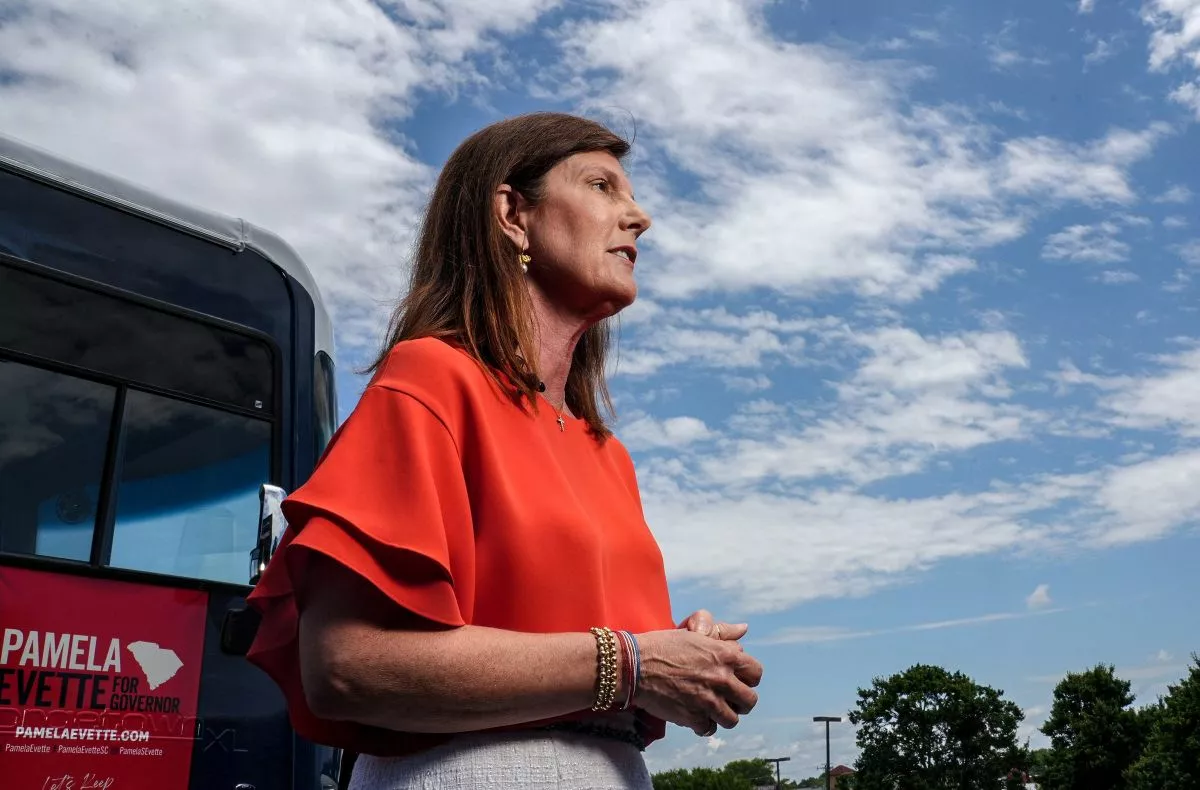
South Carolina Republicans will make the final decision on June 9, but in prediction markets, traders already seem to have a pretty strong opinion about where the race is headed. On Kalshi's market for the Republican gubernatorial nomination, Lieutenant Governor Pamela Evette has opened up a substantial lead.
As of Monday, her contract was trading around 75 cents, implying roughly a 75% probability of winning the nomination. Attorney General Alan Wilson was sitting at twenty-three percent, with the rest of the field barely registering. That doesn't mean the race is over. It shows that people willing to put money behind their predictions increasingly believe Evette is in the strongest position heading into the final days of the campaign.
The Gap Between First and Second Has Become Hard to Ignore
What jumps out isn't necessarily that Evette is leading. Most political observers have viewed her as one of the top contenders for months. The bigger story is the size of the separation that has developed between her and Wilson. A seventy-five percent probability is not a narrow lead.
It suggests traders believe Evette is much more likely than not to emerge from the primary with the nomination. Wilson remains the only candidate who appears to have a realistic chance of changing that narrative. Everyone else has been pushed into long-shot territory according to current market pricing.
Markets Are Looking Beyond Polls
One reason election markets have gained attention recently is that they are not trying to measure the same thing as a poll. A poll asks voters who they support today. A prediction market asks participants to evaluate everything they know and make a judgment about what will happen when the votes are counted.
That distinction matters because traders are constantly absorbing new information. Debate performances, endorsements, fundraising numbers, media coverage, and polling all get folded into market prices. By the time Election Day arrives, the market has usually processed months of developments rather than a single snapshot.
Why Traders Keep Buying Evette
Looking at market action over the last several months, traders have steadily moved toward Evette rather than piling in after a single major event. That type of movement is often more interesting because it suggests growing confidence rather than a short-term reaction.
Participants appear to believe she has built advantages that will hold up through Election Day. Of course, markets are not crystal balls. Political history is filled with races in which expectations and results failed to align. Still, when nearly three-quarters of market probability sits with one candidate, it tells us where collective sentiment currently resides.
Prediction Markets Keep Expanding Their Political Footprint
Election markets are becoming a bigger part of political coverage across the country. Local television stations, national media outlets, and political analysts are increasingly referencing market probabilities alongside polling data. That trend has been visible in South Carolina as well.
As more voters become familiar with prediction markets, these platforms are increasingly serving as a real-time indicator of how expectations shift throughout a campaign. Whether you view them as forecasting tools or simply another source of information, they are becoming part of the broader election conversation.
The Trade Handle Prediction Markets Take
The most interesting takeaway from South Carolina right now is not who leads the market. It is how concentrated the probability has become around a single candidate. Traders currently see Pamela Evette as the clear frontrunner, with Alan Wilson remaining the only candidate within striking distance.
That does not guarantee anything once votes start getting counted, but it does provide a window into how market participants are interpreting the race. With Primary Day now around the corner, South Carolina will soon provide an answer to one of the most important questions surrounding prediction markets. Are traders correctly reading the electorate, or is there still one final surprise left in this race?